![logo transparent 2.png]](https://support.readsidebyside.com/hs-fs/hubfs/logo%20transparent%202.png?width=100&height=50&name=logo%20transparent%202.png)
Download the science of reading alignment document! 🖨️
⚛️A program that is aligned to the science of reading for grades 3-8 will emphasize:
-
motivation and interest,
- comprehension,
- knowledge and vocabulary instruction,
- writing, and
- assessment.
😃 Motivation and Interest
At the forefront of the program's design is the emphasis on motivation and interest (Alexander, 2021), recognizing that the research evidence proves motivation is a critical factor in learning to read (Toste et al, 2020). The evidence shows students who read become better readers, and this is especially critical as students enter third-grade (Mol & Bus, 2011; Torppa et al., 2020; Van Bergen et al., 2021).
A curriculum for the intermediate grades is missing the mark if increasing students’ volume of reading isn’t its primary goal. Reading volume contributes to:
-
students’ learning of the orthographic patterns of English (Sidenberg, 2017),
-
building students’ vocabulary knowledge (McQuillin, 2019a,b), and
-
reading fluency (Brenner & Hiebert, 2010).
The heart of the program is the use of authentic, whole texts including chapter books and longer nonfiction. The volume of reading achieved in this program is unmatched. Students increase their confidence and competence.
📖Comprehension
The curriculum employs instructional routines that maximize time in reading and writing with scaffolding and differentiation built into the lesson design. The repetitive nature of the routines and skills allow for the transfer of skill and the acceleration of achievement.
The program introduces an innovative, text-structure approach to comprehension. The CIA (Collect-Interpret-Apply) approach organizes literacy instruction around full length chapter books. Students learn to "read like a detective" as they look for clues as to the author's central message or theme. Materials emphasize gathering key details, interpreting meaning, and connecting to broader themes.
The program recognizes that the goal of education is transfer; what student learn in the classroom should enable them to become better readers––at school, at home, and eventually in the workplace (Solomon & Perkins, 1990). Transfer is achieved through carefully scaffolded instruction that enables students to apply what they learn in instructional texts to new texts (Woods et al., 1976).
🌍Knowledge & Vocabulary
The program organizes text sets around cohesive, grade-appropriate themes that build knowledge over time. Each year features an overarching theme and social studies focus. Students encounter multiple texts that share related ideas. The text sets create a thematic continuity and exposure to varied genres.
A consistent structure for introducing key vocabulary is introduced through the students' Vocabulary Handbook. Students explore a single word or concept through morphemic analysis, context clues, and discussion.
✏️Writing
Materials provide opportunities for students to practice evidence based writing in both short form and long form writing.
Students use details and examples from the texts to explain explicit ideas and make inferences. There are also opportunities for students to develop opinions and analysis supported by evidence.
Writing units teach the writing process and act as a culminating activity at the end of each unit. Students practice all stages of the writing process and use the read-aloud texts as a mentor.
Writing units include narrative, expository, persuasive, and argumentative writing. These units can be downloaded from the writing page.
🎓Assessment
Materials provide opportunities for students to practice evidence based writing in both short form and long form writing.
Students use details and examples from the texts to explain explicit ideas and make inferences. There are also opportunities for students to develop opinions and analysis supported by evidence.
Writing units teach the writing process and act as a culminating activity at the end of each unit. Students practice all stages of the writing process and use the read-aloud texts as a mentor.
Writing units include narrative, expository, persuasive, and argumentative writing. These units can be downloaded from the writing page.
👍Proven to raise reading achievement!
Download the evidence study (2017).
| Read Side by Side Schools | Guided Reading Schools |
| Mean growth on the MAP test: | Mean growth on the MAP test: |
| + 21 percentile points | + 8 percentile points |
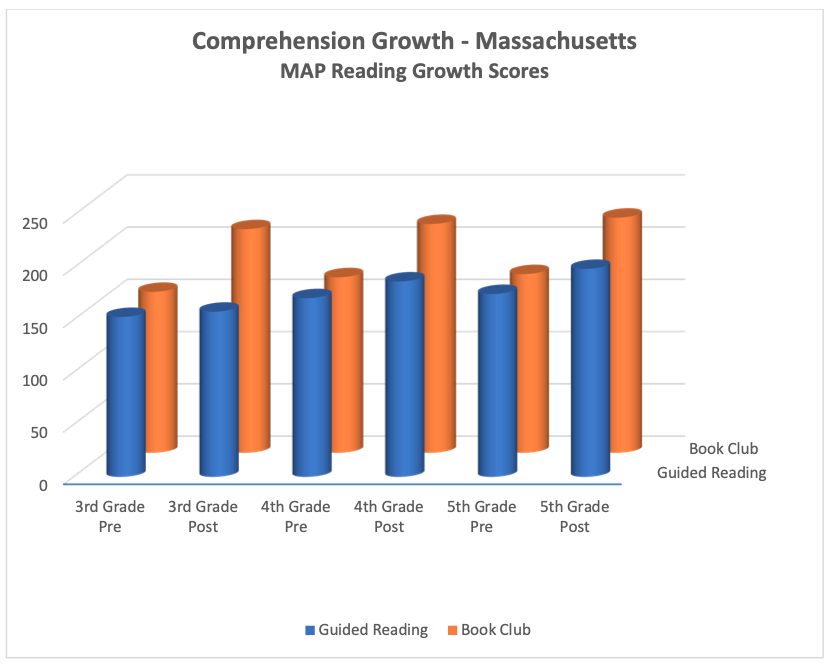
The Read Side by Side Reading Program:
- produced significant gains in reading achievement and changes in motivation (effect size .86 - Cohen's d).
- caused the students’ attitudes toward reading to change. Once exposed to an author, a genre or a topic, students wanted to read more of that author or topic.